
|
Fourway provides a broad range of contracting options to clients.
Multi-discipline design & build contracts are offered, usually with telecoms as the major element, but incorporating structural, civil, mechanical, electrical and signalling work. Fourway has proven experience undertaking such projects directly to infrastructure owners and Train Operating Companies demonstrating the capability to undertake the role of Principal Contractor. Key requirements in this role are the ability to manage the risks of large site establishments, inter-discipline design and the co-ordination of a diverse range of subcontractors.
Our design & build telecommunications project capability is offered in any size of contract from minor works to large system integration schemes. Often this service is provided in a subcontract capacity to building or signalling contractors, with Fourway bringing the required telecommunications expertise. In these instances the company prefers to adopt a partnering style with a spirit of openness and co-operation. Senior management assists this process by fostering a "can do" approach amongst project teams. This ensures contractors receive a flexible service, easily integrating with their own methods of project delivery.
Fourway Communication's many years of working 'at the sharp end' in the rail environment is also offered in its constituent parts, and can be tailored to meet the cost and contracting objectives of clients. Installation-only contracts are frequently undertaken, as are telecoms consultancy assignments and design only packages.
Fourway Communication has a separate operating division for telecommunications maintenance contracts.
The company recognises that project management has a number of facets encompassing financial planning, design, programme and resource management, safety and QA. Success can only be achieved by delivery in all these areas.
To provide these aspects, Fourway Communication offers a mature resource of experienced managers, engineers and quantity surveyors, developed over 15 years of working in the industry.
Management teams are formed for each project, using personnel with the most appropriate skills and experience. The nature of the particular project is always fully considered during selection. Senior management is involved and supports each team so that projects can benefit from strategic and objective thinking.
A key aspect for Fourway is the identification of delivery risk as early as possible in the contract. This focuses management on all the factors that can threaten completion, with the end result that projects are run proactively, achieving goals more easily than would otherwise be the case.
The management process is systemised and fully documented, providing good visibility for ease of monitoring. The approach also provides consistency and resilience to any changes in staffing. In addition, a range of software planning tools are utilised to manage high task quantity programmes.
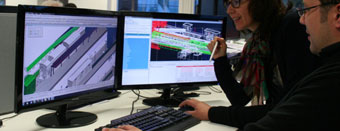
Fourway Communication adopts a structured and practical approach to design. Initially a high-level system design is produced, which identifies proposed manufacturers' products and the means of integration. System performance is established in terms of functionality, availability, maintainability and installation principles. Performance is then referenced to relevant client standards, quantifying the level of compliance achieved. Design risk assessments are included to ensure safety and environmental considerations are built in at the earliest possible stage. The 'assurance' process is completed with client participation by way of review, comment and re-submission, if required.
Installation designs are produced to define site construction, cable routes, system connectivity, asset positions and any mechanical arrangements. The company has a philosophy of basing design on thorough research, both in terms of site investigation and for new materials and equipment. All drawings are electronically produced in CAD, and undergo standardised internal checking and controlled issue procedures.
Ultimately site teams benefit from accurate, well-planned designs. The documentation produced is both clear and simple but also provides the necessary detail to control the installation process. Designers remain involved during implementation to maintain continuity and ensure efficient resolution to design queries.
The company operates an internal competence management scheme to assess and license its telecoms designers.
Signalling design and structural design is outsourced to competent approved design houses.
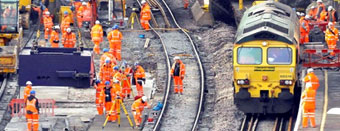
A key factor for ensuring site tasks are completed safely and on time is effective work planning. The company ensures engineers are fully conversant with the operational railway and the procedures involved in obtaining safe access to the track.
All work planning is documented in the form of method statements, which set out the sequence of tasks, resource required and any fallback contingencies. Possession arrangements and the methods for protecting staff working on or near the line are also clearly defined.
Finally, the company uses a robust system of induction and briefing to ensure these authorised arrangements are communicated properly to site operatives.
Competent, empowered site management is provided on each project to monitor and control site activity. The company believes strong leadership at this level is key to the success of the project. The company also ensures site managers can easily obtain appropriate support from head office.
 |
 |
 |
 |
Construction and Installation |
 |
 |
 |
 |
 |
Over the years, the company has developed a substantial base of resource, which is used to carry out construction and installation works. In general, this resource is dedicated to work on railway infrastructure, and therefore has the appropriate specialised knowledge and skills.
The resource is made up of company employees, supported by a number of key, approved subcontractors that provide a wider range of site skills, as well as flexibility in manning.
All site operatives undergo formal skills training, induction and competence checks, with those in safety critical roles requiring certification under the company's internal competence management scheme.
|